


Boons
- NeronAuthor
- OzzEditor

On this page 5
Boons is where the chronicle keeps track of who owes whom. Say the Sheriff looked the other way when a player's character broke the Masquerade. That's a debt and this is where you write it down. The Harpy Ledger is a separate page where the court's record gets approved and argued over.
You'll find Boons in the World group. You can't turn it off and it works the same in every edition.
The sect changes the words
The storyteller picks the chronicle's sect in Settings and the page follows it. A Camarilla chronicle keeps Boons in the Harpy Ledger and a debtor who won't pay becomes a Boon Breaker. An Anarch chronicle calls them Favors, keeps them in the Favor Ledger and has Favor Breakers. A Sabbat chronicle calls them Debts with a Debt Ledger and Debt Breakers. The buttons change to match, so New boon reads New favor or New debt. This article says boon throughout.
Writing one down
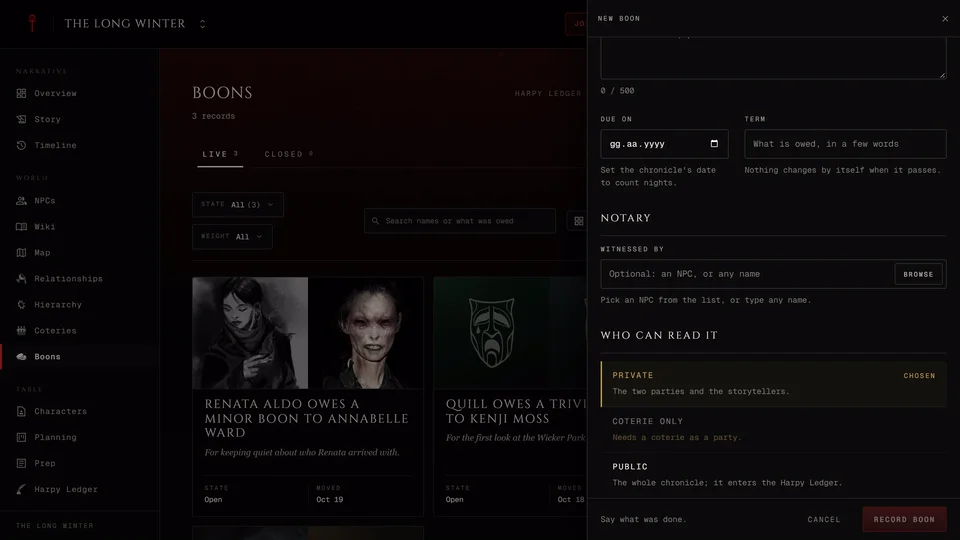
Only storytellers and co-storytellers can record a boon. Press New boon and a panel opens at the side.
Under Who owes whom pick who Owes and who Is owed. Either side can be a character, an NPC or a whole coterie. The two have to be different. Swap turns them around.
Then pick the Weight. Trivial is a small thing like an introduction. Minor means someone took a real risk or spent something. Major is a debt that needs real sacrifice to repay. Life is for when one of them saved the other's unlife. The panel starts on Minor.
Write what was done in The service. That's the only other thing you must fill in. Due on and Term are optional: an in-world night and a few words on what's owed. If the chronicle has an in-world date set the boon counts the nights down to it. Nothing changes by itself when the night passes. The boon stays open and turns up in the storytellers' waiting list as past its due night.
If someone saw the deal made put them in Witnessed by. Pick an NPC from the list or type any name.
Last comes Who can read it. Private means only the two sides and the storytellers. Public puts it in the Harpy Ledger for the whole chronicle. When one side is a coterie Private is closed and a third choice opens. It lets every member of that coterie read it. Private notes at the bottom are for storytellers only.
Press Record boon. The boon is Open straight away.
What happens to it next
An open boon can be called in, paid off, argued over or cancelled. Open the boon to see what you can do with it. The main actions are buttons on its page and the rest sit under More.
Call in asks for repayment now. You can give the night it's due when you call it in. Propose payment offers other terms and Open dispute says the record is wrong and why. Once it's repaid it's Settled. A boon that gets cancelled is Void and one the debtor refused to pay closes as Broken.
Some older boons still wait for approval before they count. A storyteller presses Approve. A public one can then wait for the Harpy, who presses Harpy Ratify (Record in Anarch and Sabbat games).
The Live tab shows everything still running. Closed has the settled and void ones. Every boon keeps a history of what happened to it on its page.
Who can do what
The two sides of a boon can call it in, propose payment or open a dispute. If a side is a coterie every player with a character in it can.
Storytellers do the rest. So can a player whose character holds the Harpy or Chancellor title. Settle records how it was repaid. Change the weight handles a partial repayment or a new deal. Transfer creditor moves the claim to someone else and Reassign debt changes who owes it. Rule on the dispute decides a disputed boon: it stands, its weight goes up or down, it's voided or it's broken. Mark broken closes a called-in boon the debtor refused to pay.
When the debtor is a character Mark Boon Breaker goes further. It voids every live boon the debtor owes and puts their name on the ledger's list of Boon Breakers. What others owe the debtor stays open. The app asks before it does this. Clearing the mark later doesn't bring the voided boons back.
Only a storyteller can change who reads a boon. A storyteller can also Void as a mistake, which closes a boon and keeps its history. A boon with no history yet can be deleted. Once it has history only the chronicle's owner can delete it. The history goes with it.
Looking through them
The list has three readings. Cards shows each boon on its own. Ledger puts them in a table with the weight and the due date. Balance adds up what each name holds and what it owes. You can filter by state and weight and search by name or by what was done.
Boons also show on the page of everyone involved. A character's, an NPC's or a coterie's page has its own boons tab with what they owe and what they hold.
Related articles

About this article
- Type
- Guide
- Editions
- All editions
Need more help?

Ask the team in #ghoulapp-feedback on the Player Companion Discord. Or try #ghoulapp. GhoulApp players are active there and help each other.
Open Discord(New tab)